Office & Workplace Lunch Delivery with Lockers: A Caterer's Guide
If you run a catering business, sandwich van or lunch round across business parks, campuses, factories and industrial estates, you already know the cost of stopping at every desk and waiting for every customer. A pre-ordered lunch service delivered once to a locker bank at each destination can simplify the route, improve convenience for staff and reduce the time each drop costs you. This guide covers the model honestly: what it can improve, what it cannot remove, and how to pilot it at one site.
The problem with the traditional lunch round
A sandwich van or lunch delivery round earns money at each stop, but each stop also costs time: parking, queuing, waiting for staff to come down, handling individual payments and repeating the process at the next unit. On a large business park or industrial estate, the selling window is short and the driving between stops eats into it.
For the workplaces themselves, the experience is mixed too. Staff break off work when the van arrives rather than when it suits them, orders get missed when someone is in a meeting, and reception areas fill up with delivery drivers at noon.
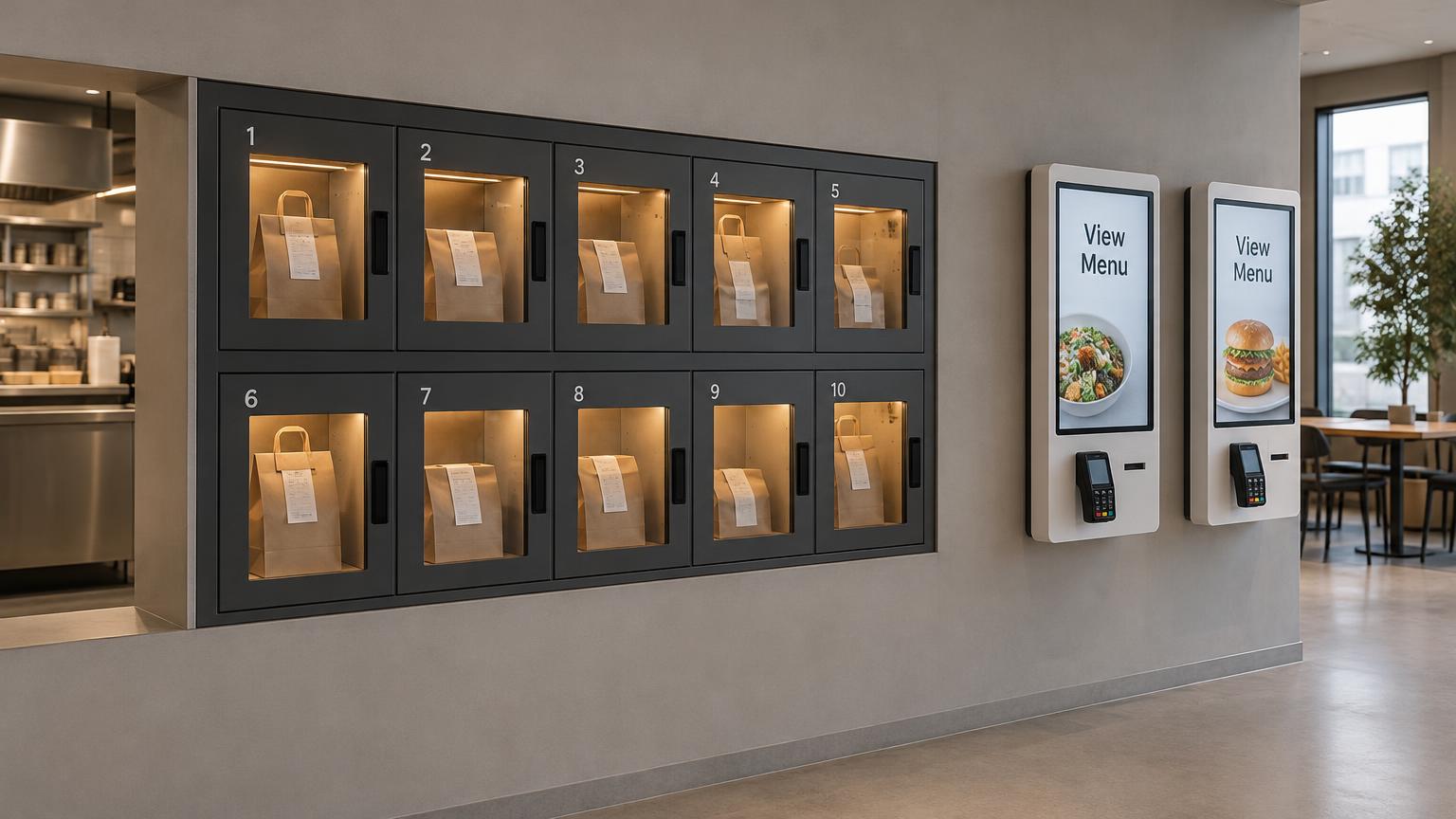
A locker-based model changes the shape of the day: customers order ahead, you prepare the orders in the kitchen, deliver each site's orders in one trip to one locker bank, and staff collect with a code when their break actually starts.
How a pre-ordered locker lunch service works
1. Staff at a partner workplace order and pay ahead — through your own ordering page, a simple repeat menu or a standing order for regulars. 2. Your kitchen prepares and labels each order with the customer's name and compartment assignment. 3. You deliver the whole site's orders in one trip and load them into the locker bank at the agreed time.
4. Each customer gets a private notification with their collection code. 5. They collect during their break within an agreed window. 6. Uncollected orders are flagged and handled under your agreed policy — a refund, a credit or safe disposal — decided with the workplace in advance.
The same model can serve corporate events and staff catering: instead of laying out a buffet that goes cold, pre-ordered individual meals can be loaded for collection at a set time. Start with the daily lunch service; add event catering once the routine is proven.
Where this model fits best
The strongest candidates are places where many people eat lunch in a short window and individual delivery is awkward: large office blocks with several tenants, business parks and industrial estates spread over a wide area, factories and distribution centres with fixed break times, and campuses where staff and students are spread across buildings.
A single locker bank at a shared entrance, reception or canteen area can serve the whole destination. For a very large site, agree one or two well-signed collection points rather than scattering compartments everywhere — simplicity is the selling point.
You need the site's permission before anything else. The building manager, facilities team or anchor tenant decides whether a locker bank can be installed, where it goes, who pays for power and what access hours apply. Approach them with a specific proposal, not a generic pitch.
What it improves — and what it does not remove
Honest benefits to test: one stop per site instead of many; no waiting for individual customers; pre-payment instead of cash handling at the kerb; a longer collection window for staff; and a predictable order count before you start cooking, which can reduce food waste compared with guessing van stock.
What it does not remove: food safety and temperature control during transport and holding, kitchen preparation time, the delivery round itself, cleaning and maintenance of the lockers, customer support when an order is wrong, and the work of winning and keeping each workplace account.
Measure before you claim savings. Time your current route per stop and per order, then compare it with the locker pilot's total cost per delivered order — including loading, driving, locker costs and support. Only then can you say truthfully whether it reduces your operating cost.
Food safety and quality come first
Hot food held too long is a safety risk, not just a quality complaint. Agree a short, realistic holding window, use insulated transport, and match the compartment to the food: ambient lockers suit packaged cold items; hot holding needs purpose-built heated equipment specified with qualified advice.
Check the food-safety registration, labelling, allergen and temperature requirements that apply to your catering operation and each country you serve. Allergen information must travel with each labelled order — a locker does not change your legal duties as a food business.
Keep food lockers separate from parcels, laundry or returns. Clean them on a schedule, log incidents, and define what happens to an uncollected order before the first customer ever orders.
The business model: who pays and what to charge
Common models to test: customers pay per order with a small delivery or service fee; the workplace subsidises the service as a staff amenity; or a hybrid where the employer funds the locker and you run the food service. Corporate event catering can be priced per head as it is now, with the locker simply replacing the buffet table.
LockerLauncher software starts from $100 per month; that is the starting software subscription, not the total setup cost. Get written quotes for the locker bank (ambient or heated), installation, power, connectivity and any integration, and use the linked startup-cost guide to build the full budget.
Contribution per order = order revenue minus food cost, packaging, payment fees and your delivery time allocation. Fixed costs include the kitchen, vehicle, lockers, software, insurance and site fees. Break-even orders per day = monthly fixed costs divided by contribution per order, divided by working days. If the contribution is zero or negative, more orders make it worse, not better.
Pilot one workplace before changing the whole round
Pick one site where you already have customers and a cooperative contact. Agree a four-to-eight-week pilot: the menu, order cut-off time, delivery time, holding window, collection point, refund policy and a review date with stop/continue criteria.
Measure orders per day, repeat customers, on-time collection rate, food-quality complaints, your time at the site versus the old round, and actual contribution per order. Ask staff what they thought — convenience is the product, so their verdict matters more than the technology.
If the pilot works, expand site by site along your existing round. Keep the van or counter service running where customers prefer it; the locker is an additional channel, not a forced replacement.
Perguntas frequentes
- Can a sandwich van or caterer deliver to lockers instead of every desk?
- Yes — the model is one pre-ordered drop per site: staff order and pay ahead, you load the site's orders into a locker bank in one trip, and each person collects with a code during their break.
- Do the lockers keep food hot?
- Standard ambient lockers do not. Hot holding needs purpose-built heated equipment and a short agreed holding window, specified with qualified food-safety advice.
- Who pays for the lockers?
- Models to test include a per-order service fee, the workplace funding the lockers as a staff amenity, or a hybrid. Confirm the full costs with written quotes before agreeing a price.
- Does this replace my lunch round?
- It can replace individual stops at large sites, but keep existing channels where customers prefer them. Pilot one workplace and measure time, costs and customer feedback before changing the whole route.
- How much does it cost to start?
- There is no universal figure. Software starts from $100 per month; get local quotes for the locker bank, installation, power and support, and budget for the kitchen, vehicle and food-safety requirements you already carry.
Fontes e leitura adicional
Estes recursos independentes apoiam os conselhos gerais de planeamento, e não as alegações sobre instalações, preços ou ganhos da LockerLauncher.
- SBA: Market research and competitive analysis
General guidance on demand, customers, location and competing services (United States).
- SBA: Calculate your startup costs
A framework for separating one-off and recurring expenses and planning break-even (United States).
- FDA: Retail Food Protection
U.S. food-safety framework; local, state and tribal regulators oversee retail food activities. Model guidance is not automatically local law or permission for food lockers.
- GOV.UK: Food business registration
UK requirement to register a food business with the local authority. Confirm the registration, labelling and allergen rules that apply to your catering operation and country.
Próximo passo: Write a one-site proposal: the workplace, expected daily orders, menu and cut-off, delivery and holding plan, full budget and pilot review criteria. Then discuss the locker specification before ordering equipment.
Related locker business use cases
Continuar a ler
- Quanto Custa Iniciar um Negócio de Cacifos Inteligentes?
- Locker Business Equipment: What to Specify Before You Buy
- Como encontrar o local certo para um negócio de cacifos
- Locker Business Legal Setup: Registration, Contracts and Local Checks
- IA e Automação: Como Gerir um Pequeno Negócio de Serviços com Mais Eficiência
- Como iniciar um negócio de cacifos
- Como ganhar dinheiro com um negócio de cacifos
- Centro de ideias de negócios para fundadores iniciantes
- Todas as ideias de negócio de cacifos