Vibe Coding Business Ideas: Turn an AI-Built Website Into a Local Service
AI tools can make it easier for an individual to turn an idea into a website or app. The opportunity is not just another digital product: you could build a useful local service with a customer-facing website and self-service locker handovers. Becoming a Lockerpreneur means connecting that digital experience to a real customer need — not assuming AI will run the physical business for you.
What vibe coding means — and where it stops
Vibe coding usually describes building software by telling an AI tool what you want, trying its output and refining it through conversation. You might prototype a booking page, service catalogue or partner portal without writing every line yourself. It is a way to explore an idea, not a guarantee that the resulting software is secure, reliable or ready for paying customers.
Start with a narrow job: let someone request a laundry collection, reserve a drill or ask about a building service. A working demonstration can help you discuss demand with customers and partners. Before launch, someone must understand the code, test permissions and payments, and take responsibility for failures. A polished page is not proof of a viable business.
Seven ideas that connect a website to a physical service
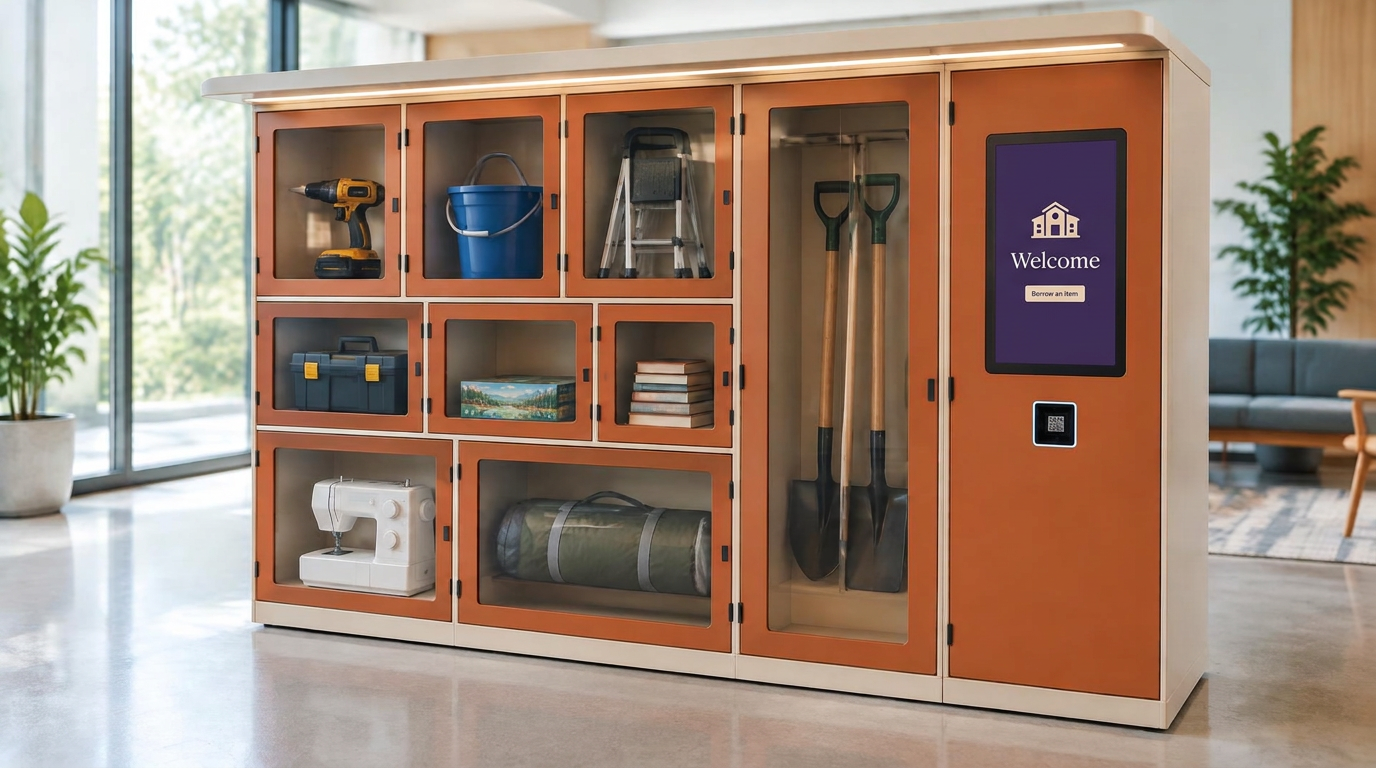
1. Apartment equipment rental: a resident reserves a carpet cleaner or drill online and collects from a locker. Your job includes buying suitable items, safety checks, damage handling and return inspections. A staffed handover may be simpler while testing demand.
2. A lending library: neighbours borrow useful items through a catalogue. Membership or a building-funded service may suit this better than charging per rental. Decide who owns, cleans, repairs and replaces items; lending is not automatically a commercial rental model.
3. Laundry and dry cleaning: a booking website connects residents to an existing cleaning partner, with locker drop-off and collection. Agree garment tracking, turnaround, claims and missed collections before selling the service.
4. Shoe repair and trainer cleaning: show service options, accept inspection requests and use lockers for handovers. Let the specialist confirm the work and price where condition matters. Photos, item labels and a clear damage policy help avoid disputes.
5. Authorised key exchange: a property or service partner schedules access for a named recipient. Verify identity and permission, set time limits and plan lost-key and emergency procedures. Do not expose key locations or access codes on a public website.
6. Parcel management: a building-facing portal could support parcel rooms in residential buildings, student accommodation, campuses or workplaces. Define recipient matching, oversized items, failed notifications and uncollected deliveries. This is often a building-funded service rather than a consumer fee per parcel.
7. Recurring food and produce collection: customers order a weekly farm box or meal-prep subscription and collect at a convenient site. Agree loading schedules, order accuracy, allergens and food-safety responsibilities. Perishable products may need temperature-controlled hardware, monitoring and collection deadlines.
Choose B2B or B2C before you build
A B2B website sells a managed service to a residential property manager, campus, workplace or local retailer. It needs a clear problem statement, site requirements and a useful enquiry form. The buyer may care more about fewer missed handovers and reliable support than a sophisticated consumer app.
A B2C website sells directly to residents or local customers. It needs accurate availability, prices, booking terms, accessible collection instructions and a way to get help. A mixed model can work, but distinguish the building contract from the resident's transaction. Do not build two complex portals before you know who will pay.
Make the USP a customer benefit, not an AI label
A useful unique selling proposition might be laundry collection near home after work, shared tools without owning them, or an authorised key handover without waiting for a staffed counter. Test whether that benefit matters enough for someone to pay. 'Built with AI' tells them how you made the website, not why they should use the service.
Lockers may make handovers more convenient, but 24/7 collection only works where customers can safely access the site around the clock. A staffed desk, delivery round or partner shop can be the better option for a small pilot. Compare the total cost and customer experience before choosing hardware.
Where LockerLauncher fits in the ecosystem
Use AI tools for research, drafts and digital prototyping; use LockerLauncher for locker software, hardware options and agreed launch guidance. Software supports open API integrations, a default building or resident interface, connection to a resident app including an own-brand white-label app, or standalone kiosk drop-off and collection. The integration scope and hardware compatibility must be agreed before connecting a custom app.
Do not let a generated website open doors directly from public browser code. Authorisation, access expiry, private credentials and reliable event handling belong in a properly secured integration. Locker access is rules-based automation; using AI to build the website does not make every locker transaction AI-powered.
Test the economics before ordering lockers
LockerLauncher software starts from $100 per month. That is the starting software subscription, not the complete startup cost. Budget separately for hardware, delivery, duties, installation, your website and AI tools, stock, insurance, partner work and ongoing support. Selected Lockerpreneur Academy applicants may receive software free for the first year*, subject to terms; other costs remain.
For a transaction model, contribution per completed order = selling price minus partner fulfilment, processing fees, consumables and other variable costs. Break-even completed orders = monthly fixed costs divided by positive contribution per order. For a building contract, compare contracted monthly income with all site costs. Include your time, replacement items, failed collections and a reserve; do not assume every compartment is always earning.
Häufige Fragen
- Can I start a business with vibe coding?
- It can help you prototype a website or app. You still need demand, a working delivery model, security checks, lawful terms and a budget before serving customers.
- Do I need lockers for an AI-built business?
- No. Lockers are one option when secure, self-service physical handovers solve a customer problem. Test a manual or partner-based service first if that is more practical.
- What is a Lockerpreneur?
- A Lockerpreneur — sometimes searched as lockerprenuer — is an entrepreneur who builds a local business around smart lockers. LockerLauncher supplies technology and launch guidance; the operator runs the service.
Quellen und weiterführende Literatur
Diese unabhängigen Ressourcen unterstützen die allgemeinen Planungshinweise, nicht die Aussagen über Installationen, Preise oder Einnahmen von LockerLauncher.
- Lovable: What is vibe coding?
The tool provider's explanation of AI-assisted conversational development; not independent evidence of launch speed, cost or business success.
- SBA: Market research and competitive analysis
General guidance on demand, customers, location and competing services (United States).
- SBA: Calculate your startup costs
A framework for separating one-off and recurring expenses and planning break-even (United States).
- Lovable: Security best practices
Official guidance on protecting credentials and enforcing security beyond the frontend. Refer to current documentation and obtain a technical review before launch.
Nächster Schritt: Choose one service and one location. Ask potential customers about the handover problem before building a prototype.
Related locker business use cases
Weiterlesen
- How to Start a Local Service Business With AI Tools: Lovable, Claude and ChatGPT
- Connecting an AI-Built Website to Smart Lockers: From Prototype to Pilot
- How Much Does It Cost to Start a Smart Locker Business?
- How to Start an Equipment Rental Business Using Smart Lockers
- Wie man ein Schließfachgeschäft gründet
- Wie man mit einem Schließfachgeschäft Geld verdient
- Ideen-Hub für Erstgründer
- Alle Schließfach-Geschäftsideen