How to Start a Local Service Business With AI Tools: Lovable, Claude and ChatGPT
You can use AI to explore an idea, organise a plan and develop a website. The strongest starting point is still a person with a problem worth solving. This guide follows a local-service founder from customer research to a controlled pilot, with smart lockers as one possible handover method rather than a requirement.
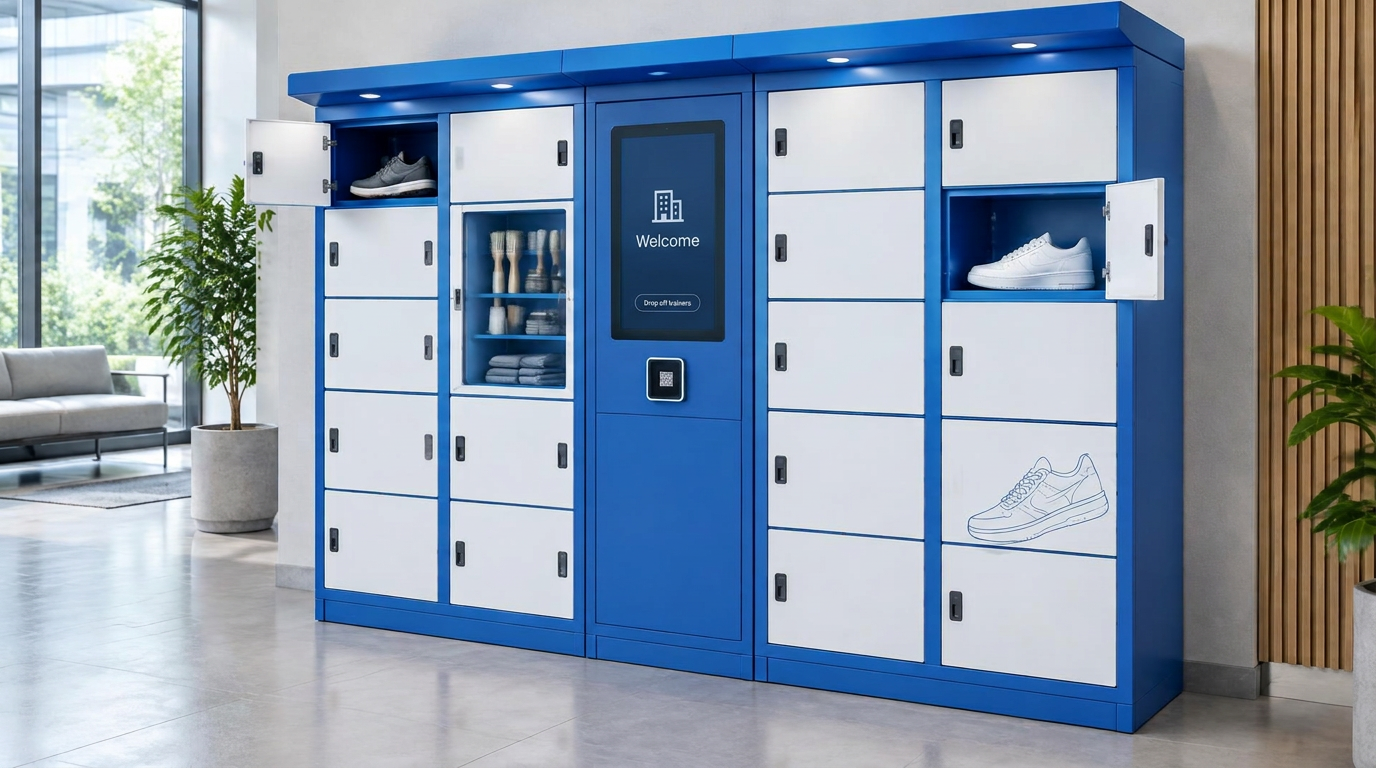
Start with evidence AI cannot invent
Choose one customer group and ask about a specific repeated inconvenience. Residents may struggle to collect laundry during shop hours; a campus team may need a better equipment handover; a property manager may spend time sorting deliveries. Ask what happens today, how often it happens and who bears the cost. Avoid asking only whether your idea sounds good.
ChatGPT or Claude can help draft interview questions and organise anonymised notes. Do not use generated customer personas as evidence of demand, and check competitor details against original sources. A search result or fluent AI answer is not confirmation of market size, legal permission or achievable pricing.
Give each tool a focused job
Use ChatGPT or Claude to challenge assumptions, compare business models, draft service descriptions and review a checklist. Ask for uncertainty and missing evidence rather than a confident promise of success. Verify current capabilities, fees and data handling in each provider's official documentation.
Use Lovable to prototype the website or app experience: a service catalogue, a business enquiry page, a reservation request or a partner view. Claude can also help with code and technical reasoning. Choose the tools that fit your skills; you do not need every subscription. These are independent third-party tools, not claims of a LockerLauncher partnership or a ready-made connector.
A useful first prompt for your website
Example prompt: 'Create a prototype for a local equipment rental service in an apartment building. Include a catalogue, a reservation request, clear pickup and return terms, accessibility and a support contact. Use sample data only. Do not take payments or unlock hardware. List what must be reviewed before launch.'
For B2B, replace the catalogue with a building-service proposal and site enquiry. For laundry, include partner turnaround and garment identification. For key exchange, use a request for an authorised handover rather than exposing credentials. Keep the prototype's scope small enough that you can explain every screen and test every action.
Design the operation before automating it
Map the full journey: booking, payment if applicable, preparation, handover, collection, return, inspection and support. Assign a person or partner to each physical step. For a lending library, schedule inspections and missing-item follow-up. For trainer cleaning, agree the specialist's acceptance criteria and the process when an item cannot be cleaned.
Write down what happens when the network fails, a customer forgets a code, a locker will not open or an item is wrong. A manual pilot with an existing shop or partner can reveal these issues before you commit to hardware. Do not sell unattended operation until support and safe access are actually available.
Check the whole budget, not just the website
An inexpensive prototype does not mean an inexpensive physical launch. LockerLauncher software starts from $100 per month; hardware, delivery, duties, installation and other services are quoted following an application. AI tools, website hosting, payment fees, stock, insurance, site agreements and your labour need separate allowances.
Compare a request-only website plus manual fulfilment with an integrated booking and locker service. Estimate revenue from your own customer conversations and quotes, not AI-generated earnings tables. Track completed paid orders, fulfilment cost, support time and repeat usage during the pilot. Scale only if the service works for customers and leaves a realistic margin.
Protect customers before you accept real orders
Test authentication, user roles, payment confirmation and data access with separate accounts. A customer must not see another person's order or collect another person's item. Keep private keys and locker credentials out of public pages and AI prompts. Use synthetic data during development and minimise what you collect at launch.
Review business registration, tax, consumer cancellation rules, insurance and local permissions. Rentals need safety and damage policies; laundry needs responsibility for garments; parcel management needs custody and escalation rules. Use qualified local advice for your actual service. Have a technical reviewer examine integrations and generated code before they control money or hardware.
Become a Lockerpreneur with a narrow pilot
LockerLauncher can complement your digital business with locker hardware options, software and agreed launch guidance. Bring the customer need, potential site, service partner and prototype to the discussion. A custom website can be considered alongside the standard interface, resident-app options or self-serve kiosk; connecting it requires an agreed technical scope.
The Lockerpreneur Academy is application-based. Selected startups receive the LockerLauncher software subscription free for the first year*, subject to terms, plus a playbook and founder support. It is not a cash grant or a promise that your launch has no cost. You remain responsible for sales, customers, partners and daily operations.
Veelgestelde vragen
- Can AI build my B2B or B2C website?
- AI tools can help create either type of prototype. Real customer accounts, payments and hardware connections need appropriate testing and review before launch.
- Is this an AI business or an AI-assisted business?
- If AI helps you build the website or draft copy while the service is rentals or laundry, AI-assisted is the clearer description. Ordinary bookings and code-based locker access are automation, not necessarily AI.
- Do I need to know how to code?
- You can explore and prototype without writing everything yourself. Production systems still need someone accountable for technical security, maintenance and integration.
Bronnen en verder lezen
Deze onafhankelijke bronnen ondersteunen het algemene planningsadvies, niet claims over installaties, prijzen of inkomsten van LockerLauncher.
- Lovable: What is vibe coding?
The tool provider's explanation of AI-assisted conversational development; not independent evidence of launch speed, cost or business success.
- Anthropic: Claude Code security
Official documentation on permissions and security when using an AI coding tool. It does not establish compatibility with LockerLauncher.
- OpenAI: GPT Actions introduction
Official explanation of connecting GPTs to external APIs. A connection requires deliberate configuration and authorisation; it is not a prebuilt LockerLauncher integration.
- SBA: Market research and competitive analysis
General guidance on demand, customers, location and competing services (United States).
- SBA: Calculate your startup costs
A framework for separating one-off and recurring expenses and planning break-even (United States).
Volgende stap: Draft a one-page service plan: customer, payer, location, handover method, partner, total costs and the result your pilot must demonstrate.
Related locker business use cases
Verder lezen
- Vibe Coding Business Ideas: Turn an AI-Built Website Into a Local Service
- Connecting an AI-Built Website to Smart Lockers: From Prototype to Pilot
- AI and Automation: How to Run a Small Service Business More Efficiently
- 20 Small Business Ideas You Can Start Without a Shopfront
- Hoe start je een lockerbedrijf
- Hoe verdien je geld met een lockerbedrijf
- Ideeëncentrum voor startende ondernemers
- Alle ideeën voor lockerbedrijven