Student Laundry Locker Service Ideas: Start With One Residence
A student laundry locker service lets residents leave an identified bag at an approved collection point and collect it after an agreed laundry partner has washed, dried and folded it. The locker handles the handover, not the washing. For an entrepreneur, laundrette or accommodation operator, the opportunity is to test whether a convenient service solves a real problem alongside existing self-service laundry facilities.
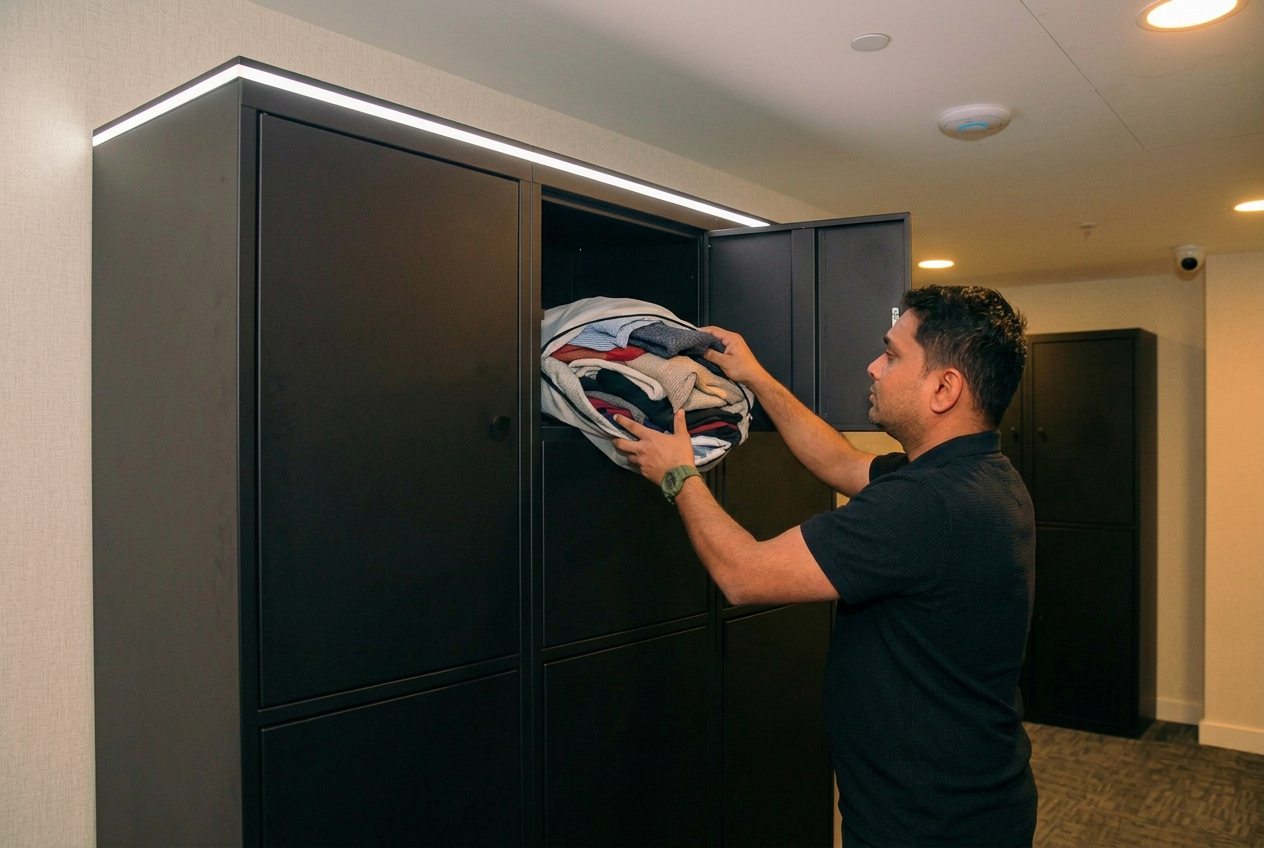
Student laundry collection is not a self-service laundromat
In a campus laundry room, students operate washing machines and dryers themselves. With laundry pickup and delivery, a provider takes responsibility for the cleaning service and returns the finished order. A smart locker can be the drop-off and collection point, avoiding an appointment for each handover where the building permits access.
Do not assume students will pay to avoid doing laundry. Ask residents about their current facilities, prices, waiting times, accessibility, drying space and willingness to buy a serviced wash. Compare doing it themselves, using a local laundrette, doorstep collection and a locker handover. Retain the existing option for students who prefer it.
Five student laundry service ideas to investigate
These are potential models, not proven demand or recommended prices. Choose one core offer before combining services. Students, the cleaning business and the accommodation operator may have different reasons to participate; identify who signs the contract and who pays.
| Service idea | Potential customer and payer | What must be organised |
|---|---|---|
| Pay-per-bag wash, dry and fold | Students paying for each completed order | Bag or weight limits, accepted fabrics, partner rate, turnaround and transport |
| A recurring term-time laundry plan | Students choosing a defined recurring allowance | Order limits, holiday pauses, cancellation, capacity and uncollected bags; no unlimited-use assumption |
| A laundrette's student pickup point | An existing laundry business extending its collection area | A host agreement, route schedule, student-facing terms and a measured cost per completed order |
| An accommodation-funded laundry amenity | A residence operator funding access or an agreed service allowance | A clear building contract; residents' cleaning charges and responsibilities remain explicit |
| Sports-club kit or specialist garment collection | Campus clubs or students buying an agreed specialist service | Keep club kit identifiable; separate dry-clean-only items and quote specialist work before acceptance |
How student laundry drop-off and pickup could work
1. The student selects the service and accepts the price, bag or weight limit, collection cut-off and turnaround. 2. They put accepted items in an identified, closed bag and deposit it in their assigned compartment. 3. An authorised driver reconciles every order when collecting it for the laundry partner.
4. The partner checks the accepted items and care instructions, confirms any exception with the customer, and completes the agreed service. 5. The finished order is returned in clean packaging to an assigned compartment. 6. The intended student receives collection instructions and collects within the stated window. Record transfers between the site, driver and cleaning partner so a missing bag can be investigated.
Set procedures for overfilled bags, pockets containing valuables, unsuitable garments, a missed route, an incorrect order, a failed door and overdue collection. A collection code is not proof that every garment was present or cleaned correctly; item identification, customer communication and a claims process still matter.
Find a student accommodation host and laundry partner
Start with one residence near a cleaning partner's existing route. Speak to the accommodation manager before approaching residents with a promised service. Check any exclusive laundry-provider contract, building procurement rules, approved communication channels, loading access, power, connectivity, accessibility, fire routes and permission to install equipment.
Agree how drivers enter without borrowing a student's door credential. Locate the point somewhere residents and authorised partners can use safely without opening private living areas to the public. State actual access hours: 24/7 student collection is only appropriate where the site genuinely allows it, not merely because the locker is automated.
Ask the laundry partner for written service scope, capacity, accepted textiles, care-label handling, collection days, turnaround, rewash and loss/damage arrangements. Agree who sells the cleaning service, who collects payment, who owns the customer relationship and who answers complaints. Do not leave students to work out which partner is responsible.
Specify lockers for bags, clean orders and real capacity
Measure the actual filled bag and finished package before choosing compartment sizes. Separate incoming used laundry from clean completed orders through an appropriate compartment and handling plan. Specify cleanable surfaces, cleaning routines and any garment-hanging requirements with the provider; ordinary lockers do not sanitise textiles, dry wet clothes or replace professional cleaning.
An order can occupy a compartment while awaiting the driver and again while waiting for the student to collect the clean bag. Model both stages, route timing, spare capacity and overdue bags rather than treating one door as one completed order every day. Do not leave wet laundry sealed for extended periods; agree acceptable deposit and holding conditions with the cleaning partner.
A standard building interface, self-serve kiosk or a scoped resident-app connection may suit the service. Check the supported booking, notification and access workflow with LockerLauncher before ordering. Integration with an accommodation portal is an agreed project, not automatic compatibility.
Budget for a full academic year, not one busy week
LockerLauncher software starts from $100 per month. This is the starting software subscription, not a complete student laundry business budget. Use the linked startup-cost guide for confirmed hardware starting terms and obtain separate quotes for equipment, delivery, installation and any integration.
Include laundry partner charges, transport and driver time, bags, payment processing, site fees, insurance, marketing, cleaning, maintenance, customer support and your labour. Contribution per completed order = customer revenue minus cleaning, transport allocation, payment fees, packaging and other variable costs. Break-even completed orders = monthly fixed costs divided by positive contribution per order. If contribution is zero or negative, extra orders do not solve that model.
Build term-time, exam-period and vacation scenarios from local evidence; do not assume every student leaves or that summer occupancy matches term time. Include the whole year's fixed commitments and cash needs. Recurring plans need clear allowances, pause/cancellation terms and a realistic view of usage, not a promise of passive income.
Reach students through useful, permitted campus channels
With permission, introduce the service through accommodation welcome information, resident communications, campus societies and a local laundry partner's channels. Explain what the customer gets: the accepted bag, real price, collection schedule, turnaround, location and support. Do not describe locker access as all-night cleaning or imply university endorsement without agreement.
Offer a clear local service page answering 'student laundry pickup and delivery', 'laundry collection in student accommodation' and 'wash-and-fold near campus' only for locations you actually serve. An educational guide can explain the model globally; a public booking page must not suggest a live campus installation before one exists. Track enquiries and completed repeat orders rather than treating video views or search rankings as proof of demand.
Pilot safely before buying or expanding a locker network
First test the service with an authorised, supervised collection arrangement and secure custody, not an unattended shared shelf. Confirm the host and cleaning agreement, appropriate insurance for goods in your care and transport, local consumer requirements, privacy arrangements and a support contact before accepting real garments or payment. Student founders must also check any visa or employment restrictions on operating a business.
For a locker pilot, agree a budget, review date and stop/continue criteria with the host. Measure completed and repeat orders, actual contribution, collection delays, compartment occupancy, route time, rewash requests, lost/damaged-item complaints and support workload. Decide who provides local cover during exams, holidays and after graduation. Expand only when customers, partners and the full-year economics support it.
Preguntas frecuentes
- What is a student laundry locker service?
- It is a collection and return service: a student deposits an identified bag, a cleaning partner washes and returns the order, and the student collects it. The lockers do not wash or dry clothes.
- Can an existing laundrette offer campus laundry pickup?
- Potentially, with the host's permission, an agreed route and cleaning capacity. Check existing campus contracts and whether the full cost per completed order makes the service workable.
- Can students collect laundry 24/7?
- Only where authorised site access genuinely allows it. Collection cut-offs, cleaning turnaround and support hours remain separate from locker access hours.
- Is a student laundry subscription passive income?
- No. Cleaning, transport, customer support, garment claims and maintenance remain necessary. Define the allowance, holiday treatment and cancellation terms, and test repeat demand and actual costs.
- How much does a student laundry locker business cost?
- There is no confirmed universal launch budget. Software starts from $100 per month; get local quotes for the complete installation, cleaning, transport, site agreement, insurance and support, and budget for the academic year.
Fuentes y lecturas adicionales
Estos recursos independientes respaldan el asesoramiento general de planificación, no afirmaciones sobre instalaciones, precios o ganancias de LockerLauncher.
- SBA: Market research and competitive analysis
General guidance on demand, customers, location and competing services (United States).
- SBA: Calculate your startup costs
A framework for separating one-off and recurring expenses and planning break-even (United States).
- GOV.UK: Online and distance selling for businesses
UK guidance on customer information, prices, delivery arrangements and cancellation for distance sales. Confirm the rules for your laundry service and country; this is not a universal cancellation policy.
- CMA: Writing a fair contract for your customers
UK guidance on clear and fair consumer terms, relevant to recurring laundry allowances, renewals and cancellation. Obtain advice for your actual terms and jurisdiction.
- GOV.UK: Workplace fire safety — your responsibilities
Fire-risk and responsible-person duties where applicable. The accommodation operator and qualified advisers must assess the proposed site; this is not approval to place lockers in a lobby.
Siguiente paso: Write a one-residence proposal: student need, payer, cleaning partner, route, access hours, full-year budget and pilot decision criteria. Then discuss the locker requirements before ordering equipment.
Related locker business use cases
Seguir leyendo
- Ideas de negocio para estudiantes: monta un servicio local mientras estudias
- Cómo iniciar un negocio de recogida de lavandería y tintorería usando taquillas
- ¿Cuánto cuesta iniciar un negocio de taquillas inteligentes?
- Locker Business Equipment: What to Specify Before You Buy
- ¿Cómo encontrar la ubicación adecuada para un negocio de taquillas?
- Locker Business Legal Setup: Registration, Contracts and Local Checks
- ¿Pueden los estudiantes internacionales iniciar un negocio? Qué comprobar primero
- Cómo iniciar un negocio de taquillas
- Cómo ganar dinero con un negocio de taquillas
- Centro de ideas de negocio para fundadores primerizos
- Todas las ideas de negocio de taquillas